Which Rhinoplasty Technique is Best For You?
, commonly referred to as a “nose job,” is one of the most transformative cosmetic procedures, helping patients achieve facial harmony, enhance functionality, or address structural concerns, but with several Rhinoplasty techniques available, how do you determine which one is best suited to your needs?
Our expertise lies in tailoring the approach to each of our patients’ goals and individual anatomy. Here’s a breakdown of the most popular Rhinoplasty techniques and how they can help you achieve your ideal outcome.
Further Reading…
Further Reading…
How Bad is Rhinoplasty Recovery?
Rhinoplasty Surgery Steps Explained by Dr Yannis
Open vs. Closed Rhinoplasty

Open Rhinoplasty
The Open Rhinoplasty technique involves a small incision across the columella (the skin between the nostrils), allowing the surgeon full visibility of the nasal structure.
Best For: Complex cases which require significant reshaping, such as correcting a deviated septum, reconstructing cartilage, or refining nasal asymmetry.
Benefits: Greater precision, ideal for intricate adjustments, gives consistent results.
Considerations: Slightly longer recovery time due to the external incision.
Closed Rhinoplasty
In Closed Rhinoplasty, all incisions are hidden inside the nostrils, leaving no visible scarring.
Best For: Subtle corrections, such as refining the nasal tip or adjusting the nasal bridge.
Benefits: Shorter recovery time, no external scarring, and reduced swelling.
Considerations: The limited visibility may mean this technique in unsuitable for more complex cases.
Reduction vs Augmentation Rhinoplasty
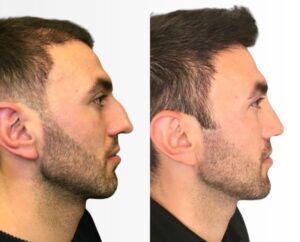
Reduction Rhinoplasty
This approach focuses on decreasing the size of the nose, addressing features such as a prominent nasal hump or wide nostrils.
Best For: Patients seeking a more proportionate profile or wanting to refine specific nasal features.
Results: A sleeker, more balanced appearance that complements your facial features.
Augmentation Rhinoplasty
For patients requiring structural enhancement, Augmentation Rhinoplasty involves adding cartilage or implants to achieve a more defined shape.
Best For: Correcting a flat or under-projected nose, often due to genetics or injury.
Results: A more prominent, harmonious nose with improved structure and symmetry.

Septoplasty or Functional Rhinoplasty
Functional Rhinoplasty, medically known as a Septoplasty, addresses medical concerns, such as breathing difficulties caused by a deviated septum or collapsed nasal valves. Septorhinoplasty is another technique used to address both the medical requirements, such as a deviated septum and the aesthetic goals of the patient.
Best For: Patients with compromised airflow or nasal trauma.
Benefits: Improves functionality, ensuring you are able to breathe more easily.
Non-Surgical Rhinoplasty
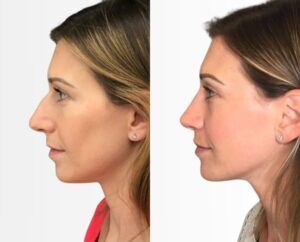
Using Dermal Fillers, Non-Surgical Rhinoplasty is a minimally invasive alternative to reshape the nose without surgery.
Best For: Patients looking for subtle adjustments, such as smoothing bumps or improving symmetry.
Benefits: Quick procedure, no downtime, and temporary results (ideal for those exploring options).
Considerations: Limited to cosmetic changes; cannot address structural or functional issues.

Which Technique is Best for You?
The right Rhinoplasty technique depends on your aesthetic goals, functional needs, and overall facial structure. During your consultation at 111 Harley St., our experts will conduct a thorough assessment to recommend the best approach, ensuring your results are tailored, natural, and in harmony with your features.
Ready to explore your options? Book a consultation with our team today and take the first step toward achieving your ideal profile.